HamiltoN'S DEDICATED SKIN STUDIO

Redness Treatment in Hamilton, Ontario
Redness Treatment in Hamilton, Ontario: A Comprehensive Guide to Calming Your Skin
3/28/202610 min read
Redness Treatment in Hamilton, Ontario: A Comprehensive Guide to Calming Your Skin
Facial redness is one of the most common yet complex skincare concerns affecting residents in Hamilton, Ontario today. Whether it manifests as a persistent flush across the cheeks, visible broken capillaries around the nose, or general blotchiness, redness can be frustrating to manage. Unlike a temporary sunburn, chronic facial redness often indicates underlying skin conditions such as rosacea, environmental damage, or inflammation.
In Hamilton, Ontario, the unique combination of fluctuating weather from humid summers to freezing, windy winters can exacerbate these issues significantly. Many people mistakenly treat redness as a simple complexion problem, using heavy makeup to cover it up rather than addressing the root cause. However, effective redness treatment requires a clinical understanding of vascular health and skin barrier function.
This comprehensive guide will walk you through the causes of facial redness, the specific triggers prevalent in the Hamilton, Ontario area, and the most advanced clinical treatments available to restore an even, calm complexion. By the end, you will have a roadmap to move from covering up irritation to actually healing your skin.
Understanding Facial Redness: More Than Just a Flush
Facial redness occurs when blood vessels in the dermis (the middle layer of the skin) dilate or break. While a temporary flush from embarrassment or heat is normal, chronic redness suggests that the blood vessels have lost their ability to constrict properly. This condition, known as telangiectasia, results in persistently visible veins and a ruddy complexion.
To understand treatment, one must first understand the physiology. The skin contains a network of capillaries that regulate temperature. When you are exposed to a trigger such as spicy food, cold wind, or stress these capillaries widen to allow more blood flow. In healthy skin, they return to normal quickly. In reactive skin, they remain dilated, leading to a constant state of inflammation.
There are several distinct types of facial redness:
Diffuse Redness: Widespread across the cheeks, nose, and forehead, often associated with rosacea.
Vascular Redness: Visible spider veins or broken capillaries (telangiectasia).
Post-Inflammatory Erythema: Red marks left behind after acne breakouts.
Seborrheic Dermatitis: Red, scaly patches often found around the nose and eyebrows.
Common Causes of Facial Redness in Hamilton, Ontario Residents
Living in Hamilton, Ontario presents specific dermatological challenges. The city’s geographical location near Lake Ontario leads to high humidity in the summer and dry, biting winds in the winter. Furthermore, urban environmental factors from the downtown core to the industrial sector contribute to skin barrier damage.
1. Rosacea: The Silent Culprit
Rosacea is the leading cause of facial redness, affecting an estimated 3 million Canadians. It is often underdiagnosed in Hamilton, Ontario because its early stages mimic a simple "sunburn" or "sensitive skin." Rosacea typically presents in four subtypes:
Erythematotelangiectatic Rosacea: Flushing and persistent redness with visible blood vessels.
Papulopustular Rosacea: Redness accompanied by acne-like breakouts (often mistaken for adult acne).
Phymatous Rosacea: Thickening of the skin, usually on the nose (rhinophyma).
Ocular Rosacea: Red, irritated eyes.
2. Environmental Stress (The "Hamilton, Ontario Factor")
Industrial heritage, combined with modern urban pollution, contributes to oxidative stress on the skin. Particulate matter in the air adheres to the skin, triggering an inflammatory response. When you mix pollution with UV radiation (which occurs even on cloudy Hamilton days), the result is a dramatic increase in free radicals that break down collagen and dilate blood vessels. Residents near the Red Hill Valley Parkway or the QEW corridor often report higher instances of skin sensitivity.
3. Lifestyle and Diet
Certain lifestyle factors common to urban professionals contribute to redness. Stress raises cortisol levels, which can trigger rosacea flares. Dietary triggers include alcohol (particularly red wine from local Niagara region vineyards), caffeine, spicy foods, and histamine-rich foods like aged cheese and cured meats. Even intense workouts at local gyms like Crunch Fitness or GoodLife in downtown Hamilton can cause temporary vascular dilation that becomes permanent over time.
4. Skin Barrier Damage (Over-Exfoliation)
A growing trend is the overuse of harsh exfoliants. Many patients arrive at clinics in Hess Village or Locke Street with "destroyed barriers" caused by using strong acids or physical scrubs daily. When the stratum corneum (the outer layer) is compromised, irritants penetrate deeper, causing chronic low-grade inflammation and redness.
Why You Can’t Just "Cover It Up" with Makeup
While green-tinted primers and full-coverage foundations can mask redness temporarily, they do not address the vascular dilation underneath. In fact, many makeup products contain fragrances or preservatives that can further irritate sensitive skin. Furthermore, the act of vigorously removing heavy makeup at the end of the day can physically aggravate fragile capillaries, leading to more broken vessels over time.
Relying solely on camouflage is a losing battle. The vessels will continue to dilate, and the redness will deepen. True redness treatment focuses on shutting down the problematic vessels or strengthening the vessel walls so they do not refill with blood.
Clinical Redness Treatment Options in Hamilton, Ontario
If you are searching for "redness treatment in Hamilton, Ontario," you have several advanced clinical procedures available. These procedures go beyond creams to physically alter the vascular structure of the skin. Below is a detailed breakdown of the most effective treatments available at leading clinics across the city from the West Mountain to Eastgate Square.
Laser Therapy: The Gold Standard (IPL and V-Beam)
Laser therapy is widely considered the most effective solution for facial redness. Two specific technologies dominate the field: Intense Pulsed Light (IPL) and Pulsed Dye Laser (PDL).
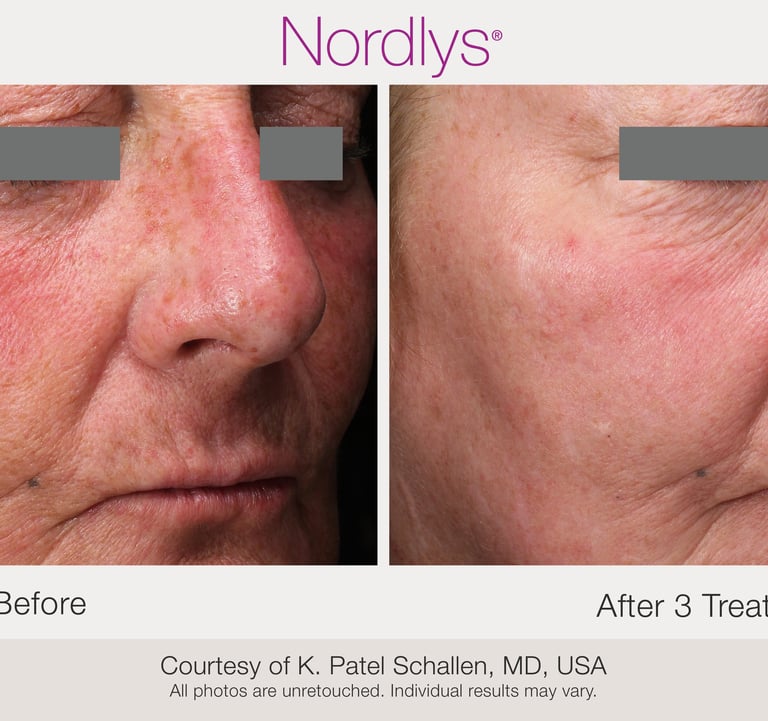
How it works: These devices emit specific wavelengths of light that are absorbed by the hemoglobin in your red blood cells. The light converts to heat, which damages the wall of the dilated blood vessel. The body’s natural healing response then removes the damaged vessel, and the redness fades.
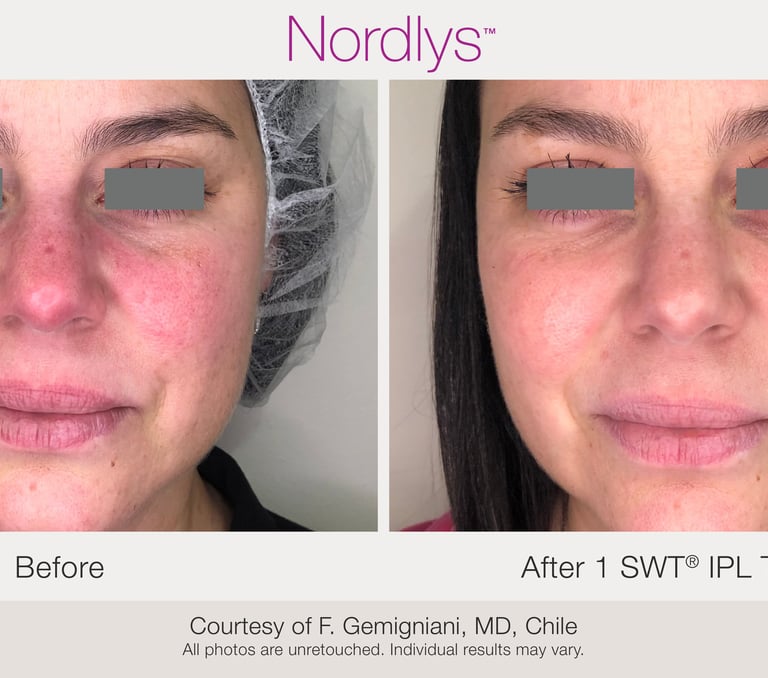
IPL (Intense Pulsed Light):
Best for: Diffuse redness, sun damage, and mild rosacea.
Mechanism: IPL uses a broad spectrum of light. It is less precise but excellent for treating large areas of the cheeks and nose.
Downtime: Minimal. You may experience mild swelling for 24 hours.
Sessions: Typically 3-5 sessions spaced 4 weeks apart.
V-Beam (Pulsed Dye Laser):
Best for: Individual broken capillaries, severe rosacea, and port wine stains.
Mechanism: This laser uses a specific wavelength (595nm) that targets blood vessels with extreme precision without damaging the surrounding skin.
Downtime: Moderate. Patients often experience purpura (bruising) that looks like small red dots for 7-10 days, though newer settings reduce this.
Sessions: 1-3 sessions are usually sufficient for significant clearance.
BroadBand Light (BBL) Therapy
BroadBand Light is an advanced form of IPL that uses computer-controlled technology to deliver precise pulses of light. BBL is often preferred in Hamilton, Ontario clinics for its ability to treat redness while simultaneously stimulating collagen production.
The advantage of BBL is its "Forever Young" BBL mode, which targets the hemoglobin responsible for redness. It is exceptionally safe for all skin types and offers minimal discomfort. Patients describe the sensation as a rubber band snapping against the skin. BBL is ideal for the patient who wants to treat redness but also improve overall skin texture and tone in one sitting.
Topical Prescription Medications
While lasers fix the vessels, prescription topicals manage the inflammation that causes new vessels to form. Dermatologists commonly prescribe:
Metronidazole (Metrocream/Metrogel):
This is a topical antibiotic and anti-inflammatory. It does not remove existing red veins, but it dramatically reduces the papules (bumps) and diffuse redness associated with rosacea. It is often used as a maintenance therapy between laser sessions.
Ivermectin (Soolantra):
Recent research has linked rosacea to an overpopulation of demodex mites on the skin. Ivermectin kills these mites, reducing inflammation. It is particularly effective for the papulopustular (bumpy) type of rosacea.
Brimonidine (Mirvaso):
This is a vasoconstrictor gel. It works by temporarily shrinking the blood vessels. A patient applies it in the morning, and redness disappears for approximately 12 hours. However, it is a temporary fix; some patients experience "rebound redness" (worse redness) when the gel wears off.
Photodynamic Therapy (PDT)
PDT is a two-step process gaining traction in for pre-cancerous sun damage and redness. A photosensitizing agent (Levulan) is applied to the skin and absorbed for 30-60 minutes. Then, a specific light is shone on the skin to activate the agent.
While traditionally used for actinic keratosis, PDT is excellent for diffuse redness caused by sun damage. It kills abnormal cells and reduces the vascular component of photodamage. The downside is significant photosensitivity for 48 hours post-treatment (you must stay out of the sun entirely).
Skincare Ingredients That Actually Reduce Redness
Clinical treatments are most effective when paired with a medical-grade skincare routine. When searching for "redness treatment in Hamilton, Ontario," a good clinic will not just sell you a laser session; they will educate you on topical support.
Niacinamide (Vitamin B3):
This powerhouse ingredient strengthens the lipid barrier and improves the resilience of blood vessel walls. It reduces transepidermal water loss, which is vital in dry winter air.
Azelaic Acid:
Found naturally in grains, azelaic acid is a dicarboxylic acid that reduces inflammation and kills bacteria. It is a first-line treatment for rosacea. It reduces the "stinging" sensation associated with sensitive skin. A 15% gel is available by prescription, while 10% serums are available over the counter.
Centella Asiatica (Cica):
This herb, also known as "Gotu Kola," is famous for its wound-healing properties. It stimulates collagen synthesis and acts as a powerful anti-inflammatory. Look for creams containing madecassoside, a derivative of Centella.
Green Tea Extract (EGCG):
Topical green tea is a potent antioxidant that reduces UV-induced redness. It calms the mast cells in the skin that release histamine (the chemical that causes flushing).
Ingredients to AVOID:
If you have redness, avoid denatured alcohol (SD alcohol), witch hazel (which contains tannins that strip the barrier), menthol, peppermint, eucalyptus, and sodium lauryl sulfate (found in many foaming cleansers).
Lifestyle Modifications for Managing Redness in Hamilton, Ontario
You can spend thousands on lasers, but if you go home and sit in a sauna or drink a bottle of Niagara red wine every night, the redness will return. Managing redness requires a 360-degree approach.
The "Trigger Diary"
Keep a journal for two weeks. Write down what you eat, the weather outside, your stress level, and the state of your redness. You will quickly identify your personal triggers. Common triggers for clients include:
Wind exposure: Walking along the Hamilton Harbor waterfront or Bayfront Park in winter.
Heating systems: Dry forced-air heating in homes and offices across the Mountain or downtown.
Exercise: High-intensity interval training (HIIT) at local gyms causes massive vasodilation.
Hot beverages: Even decaf coffee, if hot, can trigger a flush.
Skincare Application Technique
How you apply products matters. Do not use scrubs, brushes, or rough washcloths. Use only your fingertips. Pat or press products into the skin; do not rub. Rubbing creates friction, which generates heat and triggers vascular dilation. Always apply sunscreen as the final step of your morning routine mineral sunscreens (zinc oxide/titanium dioxide) are superior for redness because they sit on top of the skin and reflect heat away.
Dietary Changes
Consider an anti-inflammatory diet. Increase intake of omega-3 fatty acids (salmon, mackerel, flaxseeds) which reduce systemic inflammation. Reduce histamine-rich foods. Interestingly, some "healthy" foods are high in histamine, including avocado, spinach, tomatoes, and fermented foods like kimchi and kombucha.
What to Expect During a Redness Treatment Consultation
If you decide to pursue professional redness treatment, your first step is a consultation. Here is what a reputable clinic in Hamilton, Ontario will do:
Medical History Review: They will ask about your flushing patterns, triggers, and any medications (blood thinners like aspirin or fish oil increase bruising risk during laser).
Skin Analysis: Using a woods lamp or digital imaging, they will differentiate between pigment (brown spots) and vascular (red spots) lesions.
Test Spot: A responsible practitioner will often perform a small test spot on your jawline to see how your skin reacts to the laser before treating the whole face.
Pricing Discussion: Redness treatment is generally considered cosmetic (though rosacea treatment may be covered by some insurance if documented by a GP).
Red Flags to Watch For:
Clinics promising "permanent removal" in one session (redness requires maintenance).
Using a laser that is not appropriate for your skin type (certain lasers can burn darker skin tones).
No consultation before treatment.
The Psychological Impact of Facial Redness
It is important to address the emotional toll of chronic facial redness. Patients across Hamilton, Ontario frequently report social anxiety, avoidance of public speaking, and a constant self-consciousness. In a professional setting, a flushed face is often misinterpreted as anger, embarrassment, or intoxication.
Long-Term Maintenance Plan for Redness
Redness is a chronic condition. Even after successful laser treatment, you will need a maintenance plan. Here is a sample 12-month protocol for a client.
Months 1-3 (Active Treatment):
Laser/IPL session every 4 weeks (3 sessions total).
Prescription azelaic acid or metronidazole nightly.
Mineral SPF 50 daily (even during Hamilton's overcast winters).
Months 4-6 (Healing & Strengthening):
No laser. Focus on barrier repair (ceramides, niacinamide).
Introduce a gentle retinol 1x per week (to build collagen without irritation).
Continue trigger avoidance (wind, indoor heating, stress).
Month 6-12 (Maintenance):
One laser touch-up session (usually around month 9).
Switch to a maintenance topical (Metrogel 3x per week).
LED light therapy (red light) at home or in clinic to reduce inflammation.
Long-term (Yearly):
Most patients require 1-2 laser maintenance sessions per year to keep vessels at bay. The aging process and continued UV exposure (plus harsh winters) will always try to create new redness.
Combining Redness Treatment with Other Cosmetic Procedures
Many patients combine redness treatment with other anti-aging procedures.
Redness + Broken Capillaries on the Nose:
Often, patients with redness also have visible blue/red veins on the sides of the nose. A specific laser (Nd:YAG) is better for thick, blue veins, while V-Beam is better for thin, red ones. A good clinic will use a dual-laser approach.
Redness + Texture (Enlarged Pores):
BBL or IPL can be combined with a superficial chemical peel (like a Jessner peel) to treat redness and rough texture simultaneously. However, you cannot do them on the same day due to irritation risk.
Redness + Volume Loss (Cheeks):
As we age, we lose fat in the cheeks, which makes blood vessels more visible because there is less tissue covering them. Some patients benefit from dermal filler (like Restylane) to add volume, followed by laser to kill the surface vessels.
Preparing for Your First Redness Treatment Appointment
If you have booked a redness treatment in Hamilton, Ontario, here is how to prepare for optimal results.
Two Weeks Before:
Stop using retinols, AHAs (glycolic acid), BHAs (salicylic acid), and vitamin C.
Avoid waxing, threading, or chemical peels on the treatment area.
Stop using any topical antibiotics.
One Week Before:
Avoid tanning (natural or spray). You must have baseline skin color.
Avoid blood thinners if medically safe (aspirin, ibuprofen, fish oil, vitamin E).
Avoid alcohol (alcohol dilates vessels and increases bleeding risk).
Day of Treatment:
Arrive with clean, dry skin. No makeup, lotion, or sunscreen.
The practitioner may apply a topical numbing cream (for sensitive areas like the nose).
You will be given protective eyewear (metal shields or opaque glasses).
Immediately After:
You will feel a "sunburn" sensation for 2-4 hours.
Redness will appear worse before it gets better (this is the inflammatory healing response).
Apply cool compresses.
Do not pick at any micro-crusts that form (these fall off in 5-7 days).
Conclusion: Taking the First Step Toward Calm, Clear Skin in Hamilton, Ontario
Facial redness is not a life sentence. For too long, patients have suffered in silence, hiding behind makeup and avoiding social situations due to embarrassment over their flushed complexions. The science of redness treatment has advanced dramatically. We now understand that redness is a vascular issue, not a skincare issue.
Whether you choose V-Beam laser for severe rosacea, IPL for general diffuse redness, or BBL for a combination of redness and aging, the path forward involves clinical intervention supported by a gentle, anti-inflammatory skincare routine. You do not need to live with the burning, stinging, and visible veins.
The key is to stop treating your skin like a project and start treating it like the complex organ it is. Book a consultation with a reputable laser clinic in Hamilton, Ontario. Get a proper diagnosis. If you have rosacea, know that it is manageable. If you have broken capillaries, know they are removable.
Your skin is the first thing the world sees. Do not let redness dictate your confidence. The technology exists.